Book Review – Oswald: Return of the Kingby Edoardo Albert (historical fiction)

Here’s the blurb:

“The exiled family of King Aethelfrith of Northumbria arrive, after much hardship, on the island of Iona, where the monastery founded by St Columba has become a centre of worship and learning. Young Oswald becomes firm friends with a novice, Aidan. When Aidan professes his final vows, Oswald and his little brother Oswy are received into the church. As befits a young prince, Oswald learns to fight. However, Aidan’s example attacts him and he is on the point of deciding to become a monk when news reaches Iona that his half brother, Eanfrith, has been killed by Cadwallon, the king who defeated Edwin. Oswald sails back to Northumbria and meets Cadwallon in battle, defeating and killing him. Oswald, now undisputed king of Northumbria, gives Aidan the island of Lindisfarne as his base. But Penda, the last great pagan king in England, is raising troops against him.”

I received a free E-Arc from Netgalley.

Oswald, Return of the King is the first book I’ve read by the author.

Oswald is, unfortunately, a dense read that suffers with some pacing issues, but more than anything, is plagued by unnecessary and near constant Bible quotations. It would perhaps, have been better if the novel had been named after the monks of Lindisfarne or Iona, because the focus of the novel is not actually Oswald. The author has made great use of the work of Bede’s Ecclesiastical History of the English People, (as must everyone who writes and studies about this time period), and I couldn’t help thinking that Bede would have been overjoyed by the author’s firm adherence to his ideas – to write a history of the Church – and not a history of the people throughout this period, but for myself, I felt that this detracted from what should have been an exiting read and instead descended into a long and tedious story about a highly fictionalised accounting of how Christianity was introduced to the Saxons of England. Christianity was a weapon, just like a warrior’s sword, shield and spear, but the author, writing for a Christian Press, makes no reference to the political nature of the imposition of Christianity.

As to the story itself, Oswald does not become King of Bernicia until 48% of the book has passed, and then there is some definite fudging of events and dates which takes the reader to the final battle – or should I say ‘finally a battle’. Until this point much has been made of the amassing of troops – but the Battle of Heavenfield, where Oswald gains his kingdom, is a disappointing fight between two men in a quarry, an amassing of troops at York slithers away as a truce is called, and Maserfield is the only battle that gets any ink – even the supposed overthrow of the Gododdin earns no more than the recall of a messenger reporting to his king.

This period of history is defined by its battles and its warriors, but this is a novel of saints and Christianity, and needs to be read with a clear understanding of what it is, and not what it could have been, or what a reader might well expect it to be.

The cover is, however, stunning!

And you can buy it here:

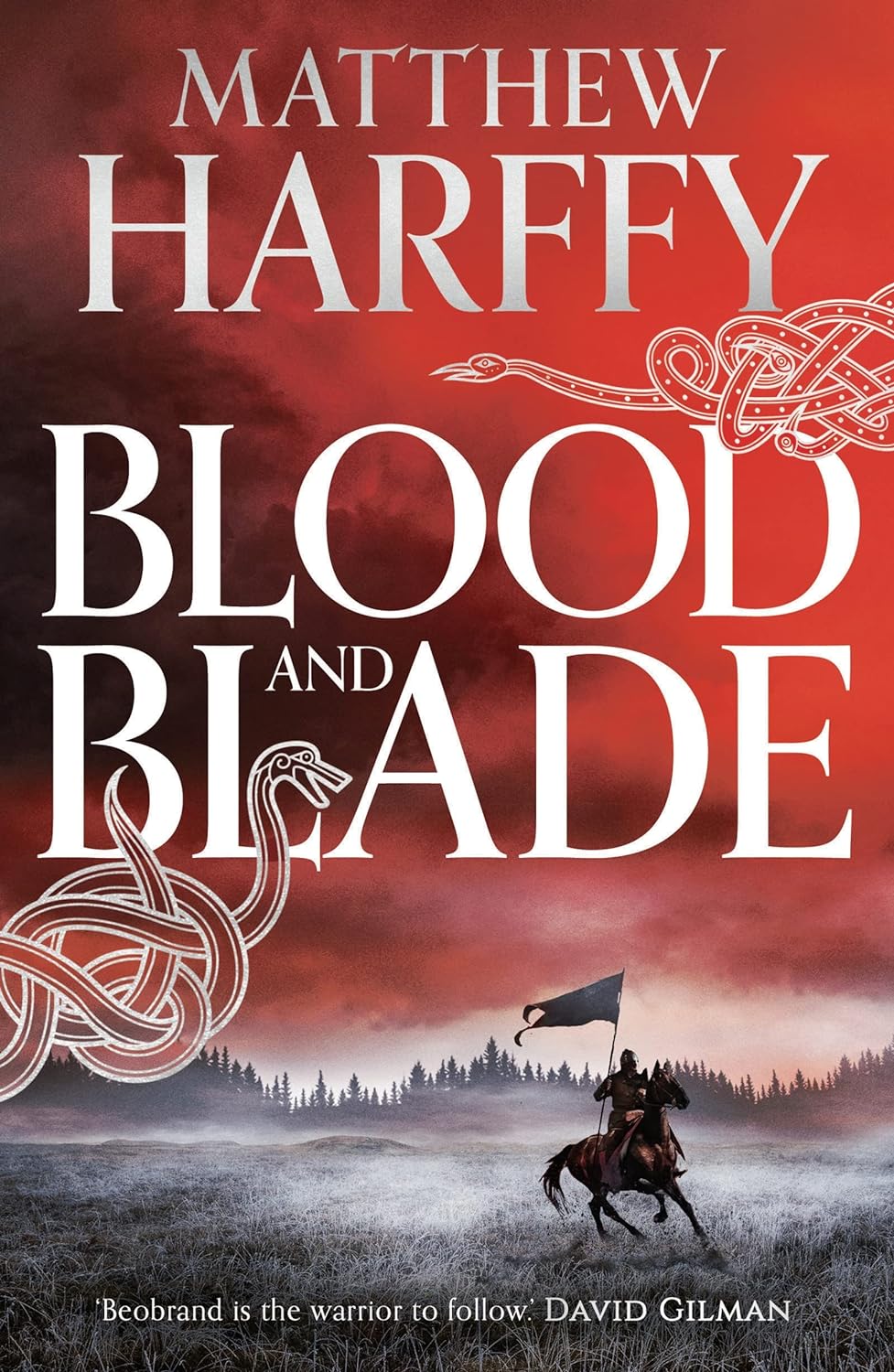
I’m reviewing Blood and Blade by Matthew Harffy #histfic #bookreview

Here’s the blurb

“635AD. Anglo-Saxon Britain. A gripping, action-packed historical thriller and the third instalment in The Bernicia Chronicles. Perfect for fans of Bernard Cornwell. 

Oswald is now King of Northumbria. However, his plans for further alliances and conquests are quickly thrown into disarray when his wedding to a princess of Wessex is interrupted by news of a Pictish uprising.

Rushing north, Oswald leaves Beobrand to escort the young queen to her new home. Their path is fraught with danger and uncertainty, Beobrand must try to unravel secrets and lies if they are to survive.

Meanwhile, old enemies are closing in, seeking brutal revenge. Beobrand will give his blood and blade in service to his king, but will that be enough to avert disaster and save his kith and kin from the evil forces that surround them?”

Cover image for Blood and Blade by historical fiction author Matthew Harffy

My Review

Blood and Blade by Matthew Harffy is the third book in his Bernicia Chronicles following the exploits of his, quite frankly, bad-tempered warrior, Beobrand. He’s no hero – he’s too self-involved, grumpy and lacks any likeable characteristics, even though the author is at pains to explain this away due to the tragedies that have befallen him in Book 2.

However, these do not excuse the foul natured monster that Beobrand has become, and I did struggle to understand why any man, or woman, would want to spend any time with him or rely on him in his guise as a warrior or a lover. He is, quite simply, lacking in any likeable qualities, without even the spark of any humour to soften his harshness, no matter how often Athelstan tries to recount his exploits in the mead hall and make them appear heroic, it simply does not work for me.

The constant shifts in point of view in chapters is annoying, but this is something that I personally don’t understand or like in any novel so it’s not a particular complaint about this author. I’m always left feeling that if the chapter needs a shift in POV then it’s either not a chapter and needs splitting, or the author needs to approach this part of the novel in a different way – give the voice of the story to a different member of the cast.

The storyline of Blood and Blade is somewhat simplistic, and you do reach a certain part of the novel and know exactly what has to happen before it reaches its end. Nothing unexpected happens to bring the novel to its conclusion. This is somewhat of a shame. I would have liked even the idea of a different ending.

The author is at pains to show society, as he perceives it, at this time, and the insistence on the small details is repetitive, as is the constant recounting of Beobrand’s aches and pains, recovering wounds and new ones that he receives.

I would reiterate that Beobrand is no hero, but neither is he an antihero. He’s been thrust into a very exciting time in history, and yet it seems that, with his constant moaning and complaining, he has no appreciation of this and is never likely to. For a young man, he often appears to be about 100 years old.

On a final note. I still do not like the way the author treats women of this period. They are either witches, bed companions, or someone else’s bed companions and are presented as petty and mean to each other. This might be a novel about a (very) grumpy warrior, but Saxon women were and should be given the place in society that they earned and deserved. Much of this is, obviously, to do with the author’s interpretation of this period, and I suppose, it is worth remembering that it is a work of fiction and not fact. Still, this is also a shame and I hope, something, that is corrected in later books to allow the author to reach a wider fan base.

Overall, the novel was enjoyable to read.