

In Candide Voltaire describes the great earthquake of All Saints Day 1755 which hit during Sunday church services resulting in the destruction of most of Lisboa and surrounding villages for miles and miles. Then Lisboa burned and was hit by a tsunami. Records and documents not destroyed in 1755 were ravaged by Napoleon’s troops. Records for the early fourteenth century were never as plentiful for Portugal as they are for France or England, and these two seminal events did not help. The larger hurdle is I do not speak or read Portuguese or the earlier spellings of medieval Portuguese, nor Spanish for that matter.
Most histories of Portugal will mention the Pedro and Inês affair in passing, not depth. The prominent chronicle surviving to this day was written by Fernão Lopes in the early fifteenth century. The extant Lopes work starts with the reign of King Pedro. Lopes’s chronicles for earlier kings are lost. Lopes proclaims an intent for historical accuracy and does a good job of balancing characters and events despite writing for the Avis dynasty. These chronicles were not available in English until 2023, and I did not trip across them until mid-2024 when my novel was already with the publisher.
There are references to other documents long lost to time. There are some records in archives and other Portuguese and Spanish cities. Professor Rita Costa Gomes wrote The Making of Court Society, a scholarly Portuguese book translated into English, though it provides some information only in Portuguese. Other useful books include: de Oliveira Marques’s Daily Life in Portugal in the Late Middle Ages, A.R. Disney’s History of Portugal and the Portuguese Empire, and Oliver Sacks’s Hallucinations.
For good or ill, my primary source was Edward McMurdo’s The History of Portugal, Volume II published in 1889. McMurdo takes a bit of getting used to; his opinions are well stirred into the history presented. Likely Portuguese/Spanish documents of recent years have updated information.
I found this legend on a trip to Portugal. Then several years later I returned to Portugal, specifically to visit the locations central to the story along with visiting museums. There is little extant material in museums from this period. I walked the grounds of a convent now in ruins in Coimbra that is central to the story. While geography changes with time, walking narrow streets and the buildings that remain from the fourteenth century helped when creating scenes.
It is in the gaps of written documents that novels unfold. It does not mean that accuracy is not important. It absolutely is. Did Pedro marry Inês? Not in the legal sense of marriage arranged for an heir to the throne. Did Pedro believe he wed her? Did Inês believe she was married? I chose to answer yes to both questions. Inês – from what we believe we know – exhibited loyalty to her friend Constanza, Pedro’s wife, and cared deeply for all of Pedro’s children. Inês did not have a child until at least a year after the death of Pedro’s first wife. Then she bears Pedro children regularly. Others suppose the love affair began before Pedro was widowed. Pedro refused to marry suitable women his father proposed after his first wife’s death. He had clergy attest to the marriage with Inês. And he never marries again, though he has a consequential affair.
There are lots of technical practices in the lives of medieval royals that are not common in our world. Technically Pedro was married before he wed Constanza. It was a marriage never consummated before it was dissolved. Often marriage agreements are bargaining tools of a king in managing relationships with other countries or inside his own country. The key is what is important to the story being told, what is critical in the history of the time, yet not a turning point for the story being told. For example, the Battle of Salado was huge in Pedro’s lifetime as was the Great Pestilence. Neither of these events is a driving factor in the legend. They are included but not critical.
The other key issue is names. Men named Pedro or João or women named Maria litter the landscape. I made a decision to use a name per person and not confuse the reader by overly focusing on titles or full proper names. It is easier if there is one central Pedro not to be confused with Pedro’s in the nobility or neighboring countries. The point is the story. For the novel, this means a Pedro in a neighboring country becomes Peter or more plainly Castile’s king. All readers know Portugal existed in the medieval period. Their likely earliest recollection is of Prince Henry the Navigator, still a century away from Pedro. Those seeking a good story are less concerned with the rabbit holes and details of history some of us find fascinating. This is the writer’s balancing act.
Let’s close with a final thought on sources and information. For many dates there is not an agreement as different sources will offer different dates for the same event. And between then and now, the calendar changed. Many birth dates and thus ages were not recorded in sources, especially for women and also children who die young. Often this is not critical to the story, the legend.
The fun part of research is falling down the rabbit holes. As I chase a fact or information about a location I can get sidetracked into reading articles on the nature of queenship, the trade between Portugal and England or the Netherlands, life on board a ship, etc. Most of the research is never used, and always worth the time to study.

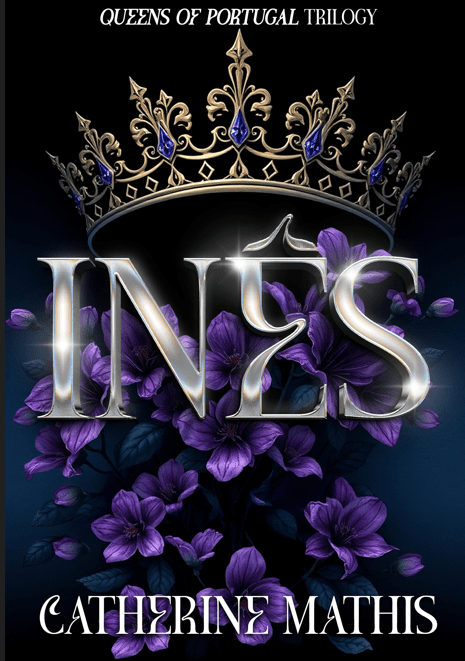
Here’s the blurb
An heir to the throne, a gorgeous blonde lady-in-waiting, the king’s trusted advisor. When a father and son don’t understand each other, the son pays an outrageous price.
Love, jealousy, loyalty, and revenge roil the court of 14th century Portugal.
In this engrossing launch to the Queens of Portugal trilogy, Catherine Mathis gives a fresh take on the tale of Pedro and Inês, Portugal’s real-life Romeo and Juliet. Pedro’s father would not have been king if not for his trusted advisor, Gonçalves. Once king, he wants no part in neighboring Castile’s royal convulsions though his son, Pedro, befriends powerful Castilians.
The all-consuming drive of the king is to ensure his line rules Portugal for centuries to come. He needs legitimate, strong heirs. The Infante Pedro loves a woman not deemed worthy to wear the crown as queen. Between father and son is Gonçalves, the king’s powerful, unquestioned counselor who is mentor to the son. Both Gonçalves and Pedro seek the attention of Inês.
There is a horrific cost to winning the love of Inês. She will not release her grip on Pedro until he keeps the two sworn oaths he made to her. Can Pedro do the impossible to satisfy Inês?
Inês is based on real people and events, exploring a cultural touchstone of Portuguese history.
Praise for Inês:
“Mathis masterfully weaves emotional depth into the narrative, creating a deeply engaging experience that leaves a lasting impression and invites readers on an unforgettable journey through the grandeur and intrigue of Portugal’s past.”
~ Mary Anne Yarde, The Coffee Pot Book Club 5* Review
“This exciting start to the Queens of Portugal trilogy describes the legendary love story of Pedro and Inês, and I was amazed at the excellent storytelling and how the author brings the courts to life. There is a lot of drama and intrigue, and the characters’ emotions are beautifully captured in this engrossing tale.”
~ Readers Favorite 5* Review
Purchase Link
https://books2read.com/u/br8OBY
Meet the author
Catherine Mathis was born in Berlin, the daughter of an American spy. As she grew up in Washington, D.C., her spy father turned into a drug enforcement agent. His career change wrecked any chance at high school popularity. She graduated from Sewanee | The University of the South with a degree in history focused on the medieval period. After a career in finance, she returned to her first love of medieval history to ‘Share Iberian Tales.’ Outside of writing, spare time joys are family, friends, reading, collecting folk/outsider art, and travel.

Connect with the author

















 MJ Porter