Author of Saxon historical fiction and non-fiction, 20th-century historical mysteries, and Norse-inspired historical romantasy. Book reviewer and blog host.
Author: MJ Porter, author
I'm an author of historical fiction (Early England/Viking and the British Isles as a whole before 1066, as well as five 20th-century mysteries), a non-fiction title about the royal women of tenth-century England, and historical fantasy.
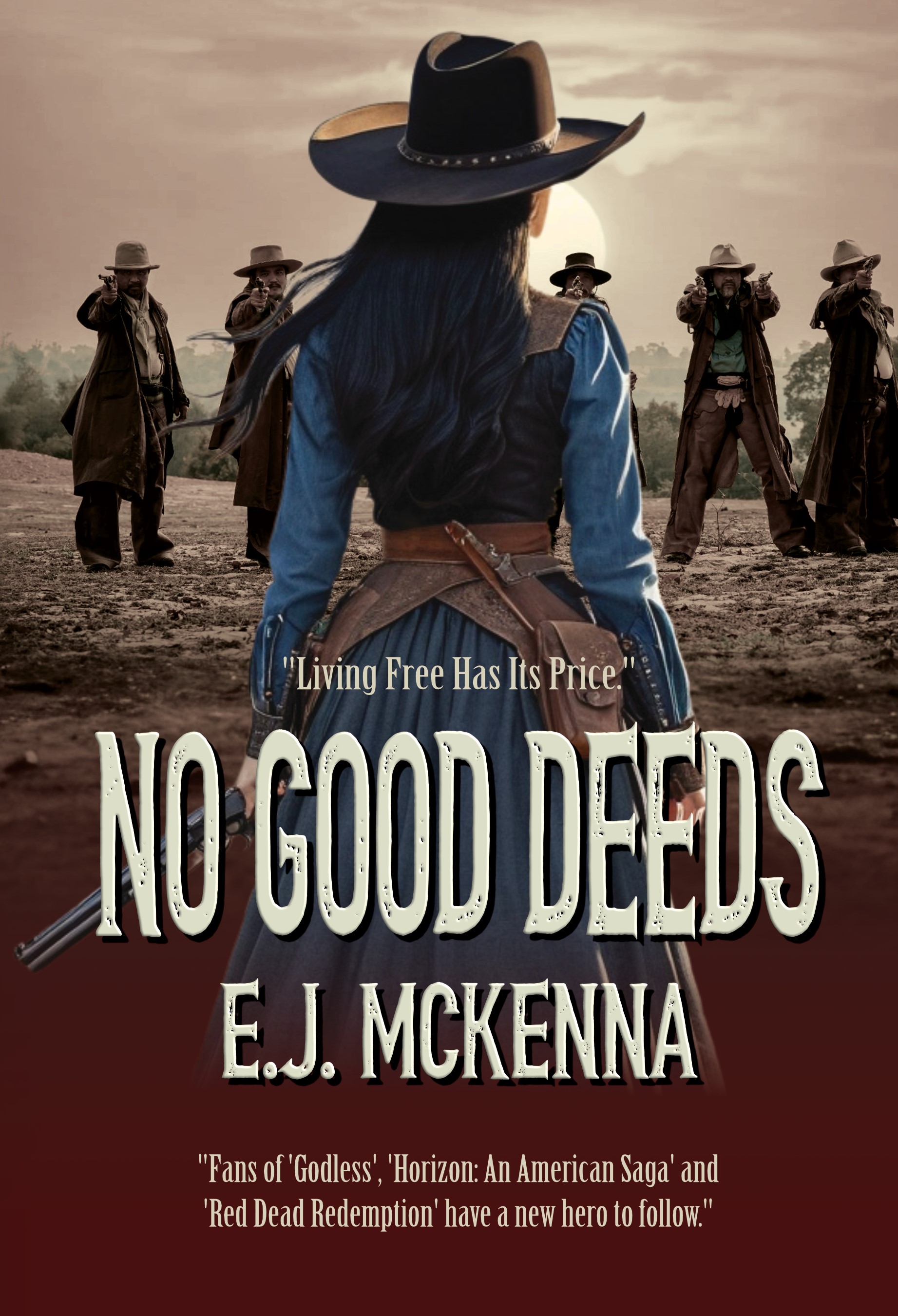
I’m delighted to welcome E.j. McKenna and her new book, No Good Deeds, to the blog with an excerpt.
Excerpt
“You know what I want beyond all else in this world? Four walls and a roof. All my own. Don’t even need another room.” She gave an embarrassed laugh. “I know it’s simple, but I ain’t never had that. It’d be out of town, but not too far out, maybe close to a river, I dunno. I’d be a Bounty Hunter or a Trapper or somethin’, to pay any costs I have. And I’d live off the land, all quiet like.”
Blurb
Annie Schaeffer is no stranger to violence. Born of an outlaw father, she was sold to a traveling show at the age of six, now finally escaping as an adult.
On the run and wounded, she finds an unlikely ally In Nathan Healey – a member of the Needham Boys gang.
As she earns her place among the outlaws, Annie’s survival hinges on her lethal skills and growing bond with Nathan.
Nate’s moral compass shifts with his circumstances, especially when those he loves are involved. Upon meeting Annie, he finds himself drawn to a woman determined to live differently to the expectations others place upon her; to live freely and fairly. The way he has always wanted.
Annie’s quest for independence takes a dark turn as the gang begins to collapse. Betrayal runs deep, and the cost of trust is high.
No Good Deeds is a gripping tale of resilience and retribution in the untamed West, where loyalty is fleeting and justice is won at the barrel of a gun. Annie Schaeffer’s story is one of fierce determination, as she battles her past and the outlaws who seek to control her fate.
E.J. McKennais a freelance writer in the UK with a great interest in American History, and a degree in English and American Literature with Creative Writing from the University of Kent.
At the end of 2023, she co-created a creative writing app for people of all ages to improve their writing skills in a fun, relaxed environment.
Born and raised in the UK, but a lover of traveling, she has a fascination with all social history across different countries and cultures. One of her favourite historical periods is the Victorian era, especially with United States history.
“The juxtaposition between the established countries of Europe, and the new world of America is fascinating to me. So many people trying to survive harsh frontier life, while trying to continue the uptight decorum of Victorian society.”
A huge advocate for feminism and human equity, her writing centres around determined female protagonists in traditionally male roles, tackling the perceptions of women in history. Her strong female protagonists go out of their way to change their society’s expectations for the fairer.
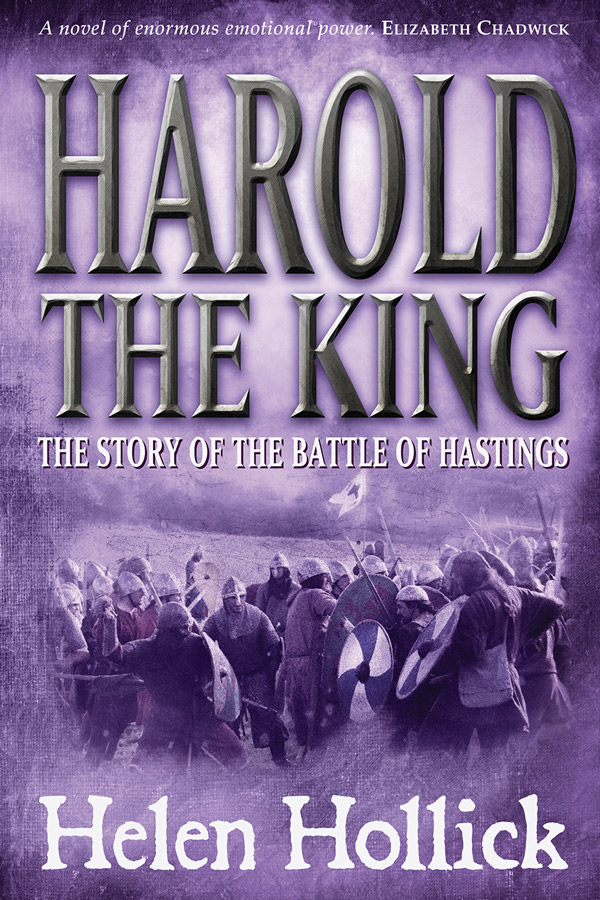
I’m delighted to welcome Helen Hollick and her book, Harold The King (UK)/ I Am The Chosen King (USA/Canada), to the blog.
Blurb
First published in 2000 – Celebrating a Silver Anniversary!
The events that led to the Battle of Hastings and the Norman Conquest of England in 1066 – told from the English point of view.
Two men. One crown.
England, 1044. Harold Godwinesson, a young, respected earl, falls in love with an ordinary but beautiful woman. In Normandy, William, the bastard son of a duke, falls in love with power.
In 1066 England falls vulnerable to the fate of these two men: one, chosen to be a king, the other, determined to take, by force, what he desires. Risking his life to defend his kingdom from foreign invasion, Harold II led his army into the great Battle of Hastings in October 1066 with all the honour and dignity that history remembers of its fallen heroes.
In this beautifully crafted tale, USA Today bestselling author Helen Hollick sets aside the propaganda of the Norman Conquest and brings to life the English version of the story of the man who was the last Anglo-Saxon king, revealing his tender love, determination and proud loyalty, all to be shattered by the desire for a crown – by one who had no right to wear it.
Praise for Helen Hollick
“Helen Hollick has it all! She tells a great story, gets her history right, and writes consistently readable books”
~ Bernard Cornwell
“A novel of enormous emotional power”
~ Elizabeth Chadwick
“Thanks to Hollick’s masterful storytelling, Harold’s nobility and heroism enthral to the point of engendering hope for a different ending…Joggles a cast of characters and a bloody, tangled plot with great skill”
~ Publisher’s Weekly
“Don’t miss Helen Hollick’s colourful recreation of the events leading up to the Norman Conquest.”
~ Daily Mail
“An epic re-telling of the Norman Conquest”
~ The Lady
“If only all historical fiction could be this good”
This title is available on #KindleUnlimited, except in US & Canada
Meet the Author
First accepted for traditional publication in 1993, Helen became a USA Today Bestseller with her historical novel, The Forever Queen (titled A Hollow Crown in the UK) with the sequel, Harold the King (US: I Am The Chosen King) being novels that explore the events that led to the Battle of Hastings in 1066. Her Pendragon’s Banner Trilogy is a fifth-century version of the Arthurian legend, and she writes a nautical adventure/supernatural series, The Sea Witch Voyages. She has also branched out into the quick read novella, ‘Cosy Mystery’ genre with her Jan Christopher Mysteries, set in the 1970s, with the first in the series, A Mirror Murder incorporating her, often hilarious, memories of working as a library assistant. The fifth in the series, A Memory Of Murder, was published in May 2024.
Her non-fiction books are Pirates: Truth and Tales and Life of A Smuggler. She is currently writing about the ghosts of North Devon, and Jamaica Gold for her Sea Witch Voyages.
Recognised by her stylish hats, Helen tries to attend book-related events as a chance to meet her readers and social-media followers, but her ‘wonky eyesight’ as she describes her condition of Glaucoma, and severe arthritis is now a little prohibitive for travel.
She lives with her family in an eighteenth-century farmhouse in North Devon with their dogs and cats, while on the farm there are showjumper horses, fat Exmoor ponies, an elderly Welsh pony, geese, ducks and hens. And several resident ghosts.
Welcome to the bouncy castle of Los Angeles in 2004. At the dawn of social media, Carla and Pete embark on a quest for meaning in a city where dreams often fade into the smog. They came for indie rock stardom, only to find themselves sidelined by life’s realities and their own emotional limitations. Carla experiences the true meaning of monotony as a TV extra, while Pete, wrestling with societal views on bisexuality, answers phones. Despite their mutual affection, Carla feels rejected, while Pete, secretly grappling with his identity, shies away from intimacy.
Their world, filled with vinyl records, a spirited cat named Joni, and an eccentric Hollywood landlady, offers fleeting moments of deep connection. But the arrival of a charismatic stranger disrupts their fragile status quo, forcing them to confront faded ambitions and the true nature of their relationship.
With the pop culture eye of Bret Easton Ellis and lyrical longing of Just Kids by Patti Smith, Somewhere in Hollywood explores the tight-rope walk of personal growth and relationship dynamics, capturing the soul of a generation in search of itself and the relentless pursuit of something more.
Lisa C. Michaud is the author of “Slanted and Disenchanted.” Her writing has been featured in xojane, Narratively, and several indie zines. She resides with her family and cat just outside Paris, where she collects vinyl while penning her next narrative.
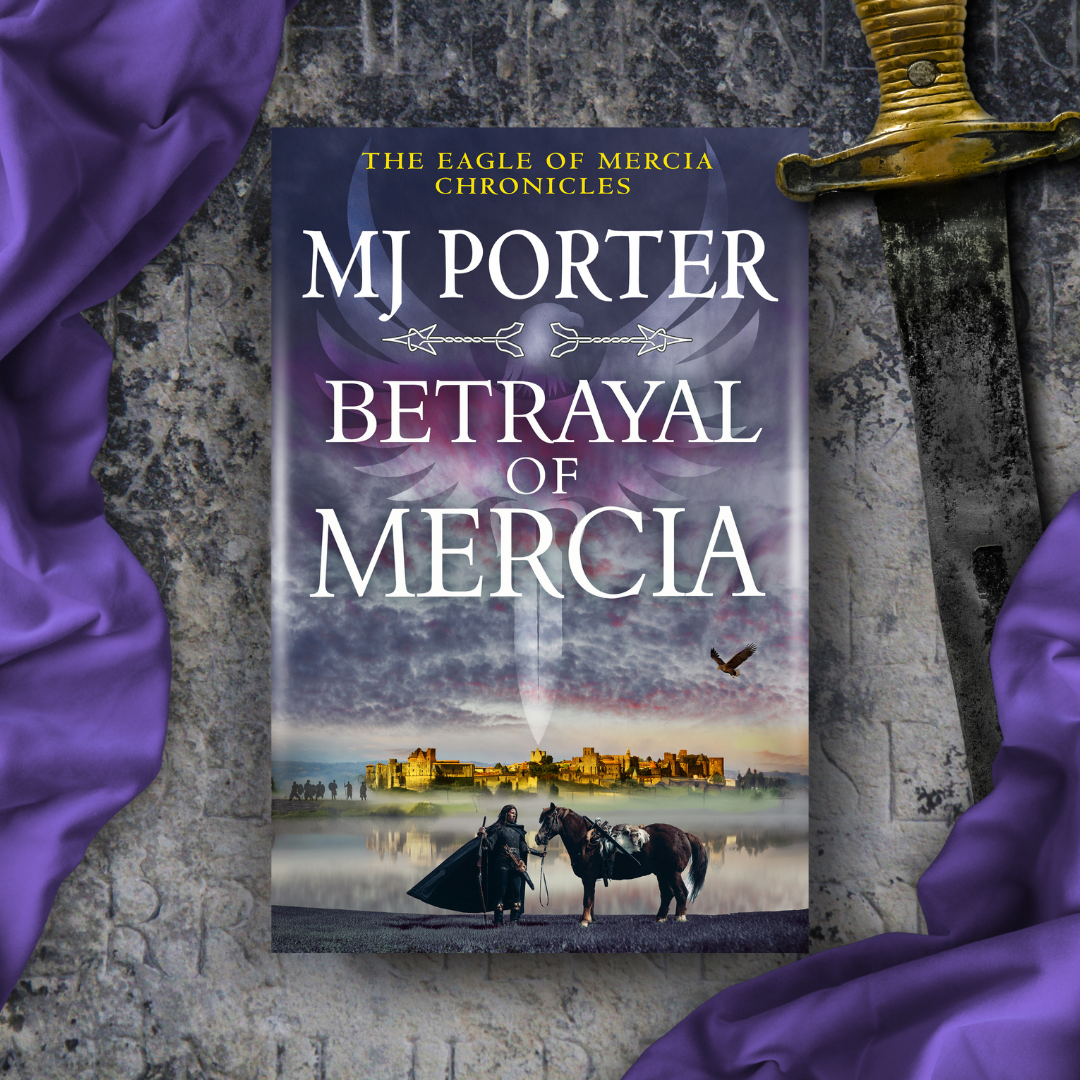
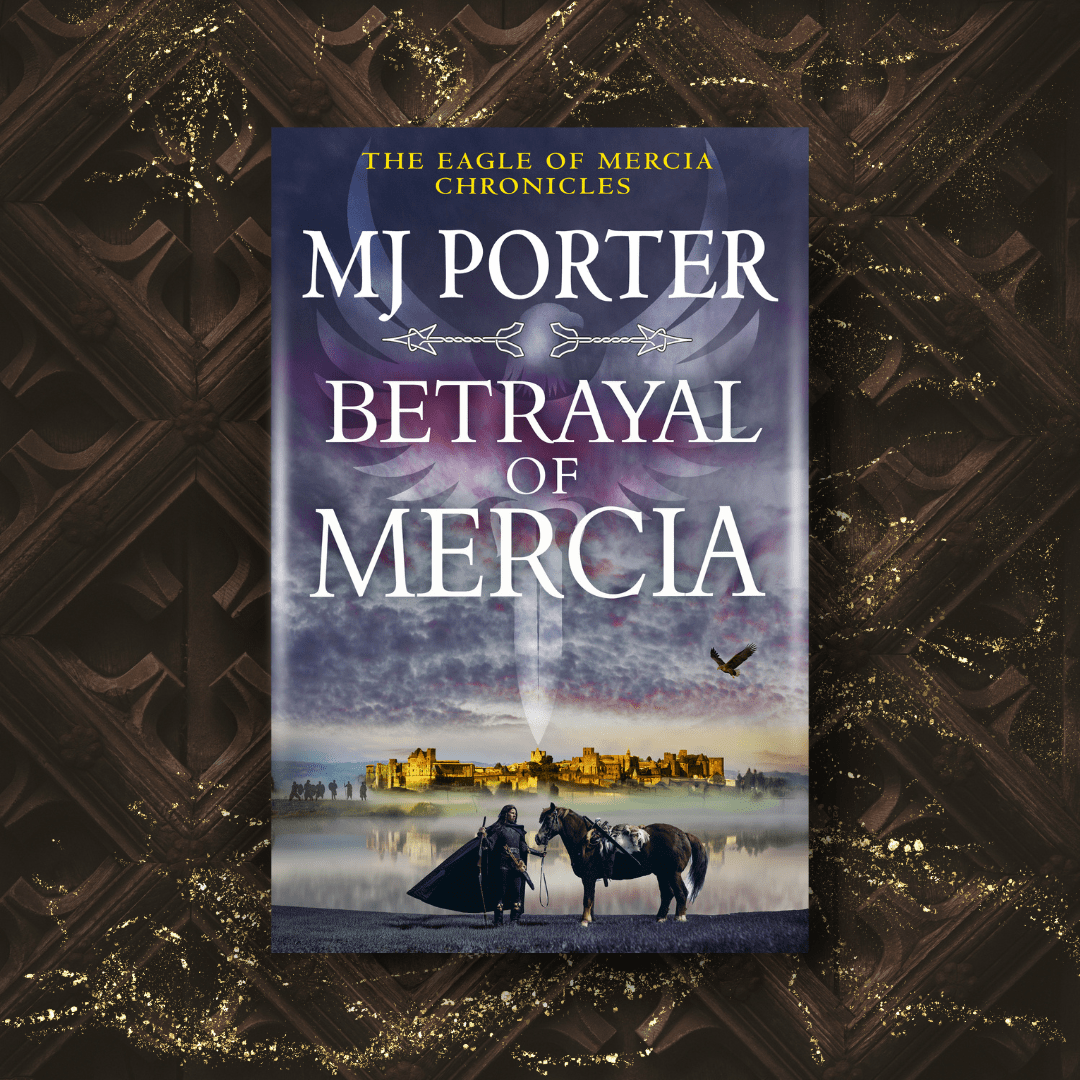
A King in crisis, a Queen on trial, a Kingdom’s survival hangs in the balance.
Londonia, AD835 The deadly conspiracy against the children of Ealdorman Coenwulf is to be resolved. Those involved have been unmasked and arrested. But will justice prevail?
While the court convenes to determine the conspirator’s fate, King Wiglaf’s position is precarious. His wife, Queen Cynethryth, has been implicated in the plot and while Wiglaf must remain impartial, enemies of the Mercia still conspire to prevent the full truth from ever being known.
As Merica weeps from the betrayal of those close to the King, the greedy eyes of Lord Æthelwulf, King Ecgberht of Wessex’s son, pivot once more towards Mercia. He will stop at nothing to accomplish his goal of ending Mercia’s ruling bloodline.
Mercia once more stands poised to be invaded, but this time not by the Viking raiders they so fear.
Can Icel and his fellow warriors’ triumph as Mercia once more faces betrayal from within?
An action packed, thrilling historical adventure perfect for the fans of Bernard Cornwell and Matthew Harffy
Here’s the purchase link (ebook, paperback, hardback and audio)
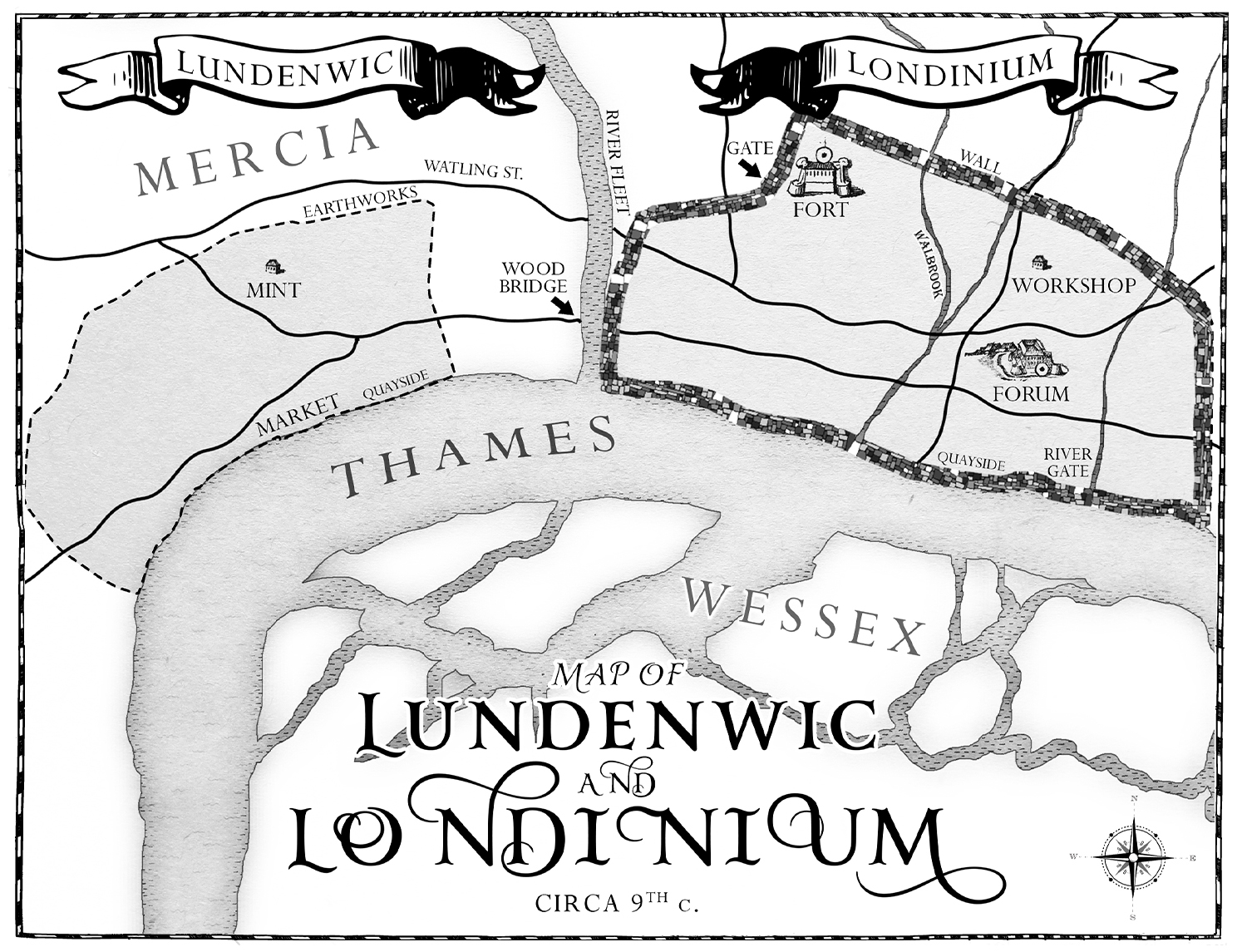
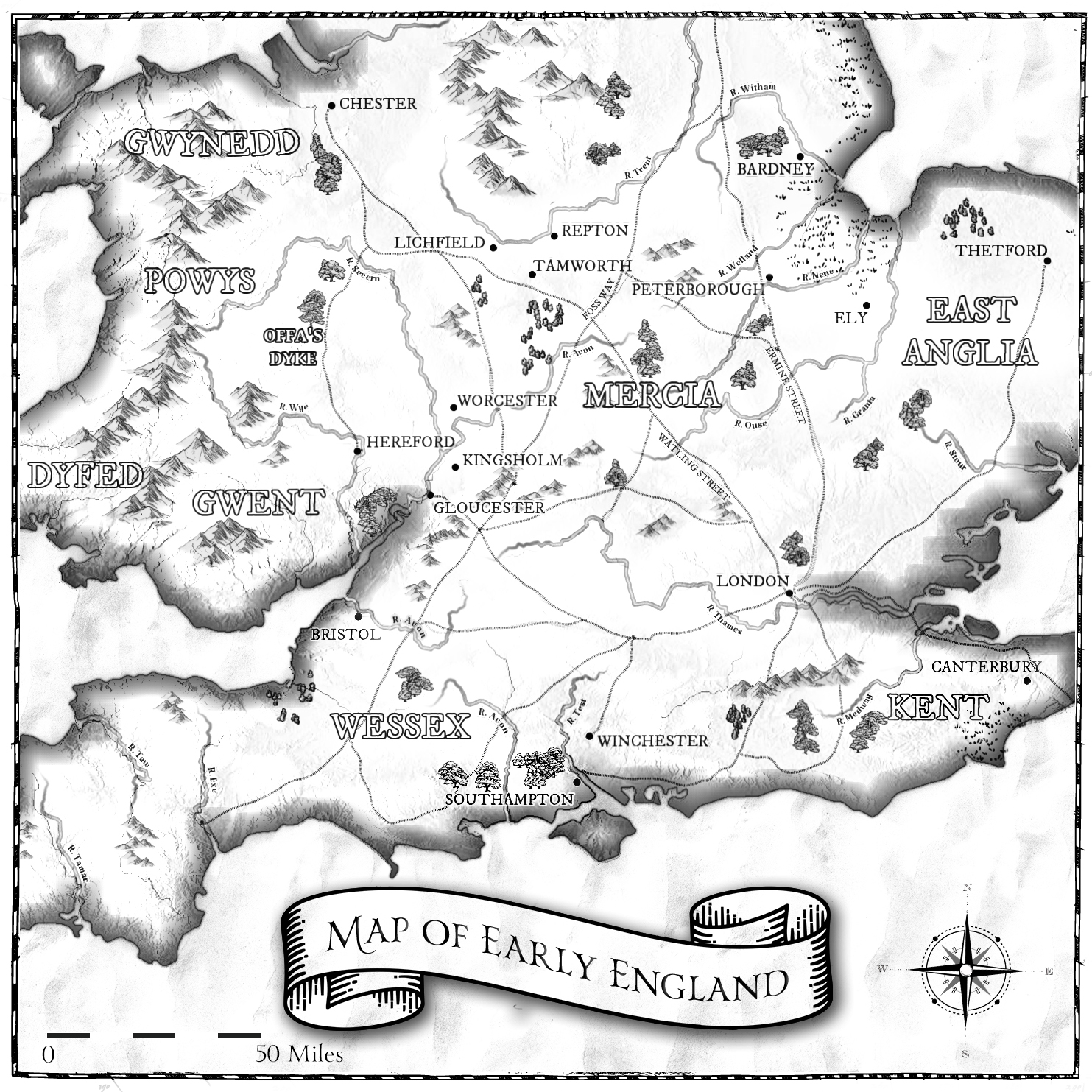
Throughout the series I’ve taken young Icel to some interesting locations, and that means I’ve had to make use of many maps which are recreations of the era, because, alas, we have none from the period. Both maps I’ve had made are relevant to Betrayal of Mercia which largely takes place in London, or Londonia, or Londinium and Lundenwic.
The map of Lundenwic and Londinium, shortened in the books to Londonia, a term more accurately applied to the eighth century and not the ninth, is much simplified and largely shows locations relevant to me and which I need to remember when writing the books. Although, I must confess, I did forget about it in the drafting process and when I found it, I was relieved to discover I hadn’t made THAT many mistakes.
The most important elements to understand are that ‘London’ as we know it didn’t exist at this time. Instead, there were two very distinctive settlements, and they were seperated by the River Fleet, one of London’s ‘lost’ rivers because it’s now subterranean. I think, for me, not being very familiar with London as it is today actually helped. Rather than trying to orientate myself as to what’s there now, I can work the other way round. I sort of know what was and wasn’t there in the ninth century, and then I can try and work out what’s there now:) Honestly, it makes sense to me.
It also helps to remember that despite London now being the capital of England, it wasn’t in the ninth century. Far from it, in fact. There are many good books on London in it’s earliest manifestations. If you’re interested, they are very worth checking out.
I also have a map of England at this time. This is to help readers (and me) try and get an idea of what settlements were and weren’t there at the time. As I’ve learned, it can be far too easy to just assume the longevity of a location, and then discover it wasn’t there at all, was bigger or even, much smaller than it is now. One of those locations is Wall, close to Lichfield, which was very important during the Roman occupation of Britain, but is now little more than ruins. And it’s far from alone in that.
A King in crisis, a Queen on trial, a Kingdom’s survival hangs in the balance.
Londonia, AD835 The deadly conspiracy against the children of Ealdorman Coenwulf is to be resolved. Those involved have been unmasked and arrested. But will justice prevail?
While the court convenes to determine the conspirator’s fate, King Wiglaf’s position is precarious. His wife, Queen Cynethryth, has been implicated in the plot and while Wiglaf must remain impartial, enemies of the Mercia still conspire to prevent the full truth from ever being known.
As Merica weeps from the betrayal of those close to the King, the greedy eyes of Lord Æthelwulf, King Ecgberht of Wessex’s son, pivot once more towards Mercia. He will stop at nothing to accomplish his goal of ending Mercia’s ruling bloodline.
Mercia once more stands poised to be invaded, but this time not by the Viking raiders they so fear.
Can Icel and his fellow warriors’ triumph as Mercia once more faces betrayal from within?
An action packed, thrilling historical adventure perfect for the fans of Bernard Cornwell and Matthew Harffy
Here’s the purchase link (ebook, paperback, hardback and audio)
In Betrayal of Mercia, the seventh book in the Eagle of Mercia Chronicles featuring young Icel, I’ve done something that I don’t ‘think’ anyone else has done before. I’ve staged a criminal trial, making Betrayal part court-room drama and part action-thriller (you know Icel is always going to end up in a fight at some point). However, there are odd things about Saxon England that we have no information about – one of them is how often people actually went to church once Christianised, another is exactly how the law was enacted.
This might seem like an odd thing to say. Everyone knows there are surviving law codes from the era, especially from the eleventh century, with the inspiring names of Æthelred I or Cnut II, and indeed, the earliest law code dates back to Ine, in the seventh century, from which we can glean such titles as Wealas or foreigner, but applied to the Welsh, who had different wergild payments and punishment from the Saxons. But, there has long been an argument about how much these law codes reflect practise as opposed to an ideal. And some of the elements we ‘think we know’ turn out to be on much less steady ground. And, at the heart of all this is a problem with our current perceptions of ‘right,’ ‘wrong,’ and ‘justice.’ We ‘appear’ to look at these elements of our current legal system in a way very different to the era.
When studying what records we do have, we’re greeted with some interesting terms. ‘Thereafter there would be no friendship,’ appears in a charter detailing a land dispute in the later tenth century – between Wynflæd and Leofwine (S1454 from 990 to 992). In this, despite whoever was in the wrong or the right, the decision was made which was something of a compromise – both injured parties had to make concessions. No one truly ‘won’, even though Wynflæd had many who would speak on her behalf, including the king’s mother, and the Archbishop of York, and had appealed directly to the king, Æthelred II, for assistance, only for Leofwine to refuse to attend his summons saying that royal appeals couldn’t precede a regional judgement on the matter.
In the famous case of Lady Eadgifu of Wessex (recorded in charter S1211), the mother of Kings Edmund and Eadwig (who features in the Brunanburh series), her landholdings at Cooling required the intervention of her husband, stepson, son and grandson, in a long-running debacle which was never really resolved until her grandson intervened close to the end of her life. Even though she appears to have held the ‘landboc’ – the title deed for the land – and was a highly regarded member of the royal family, this wasn’t enough to stop counterclaims. In the end, she assigned the land to the Christ Church religious community, and that way, no one actually benefitted apart from the church.
These cases both refer to land disputes, which are one of the larger areas of document survival, along with wills. But what about crimes visited against the king’s mund (both his physical person and his physical kingdom)? Here, we’re again confronted with little knowledge. We know of ealdormen being banished (under Æthelred II) and this attests to another element of the practise of law which is perhaps surprising. There does seem to have been an aversion to capital punishment (as Rabin details in his book mentioned below). And there was also a concern that the right sentence was handed to individuals – it was as bad to incorrectly punish as it was to have committed the crime.
In trying to stage a trial set in the Saxon period (which I now realise was a bit bonkers), I’ve relied heavily on a very short book, Crime and Punishment in Anglo-Saxon England by Andrew Rabin, and also his translations of the Old English Legal Writings by (Archbishop) Wulfstan (from the 1000s), from which I’ve determined how many oath-helpers people must have based on the Mercian Wergild listed within the source documents. This suggests the value placed on individuals – the king, of course, being at the top. Each individual had a wergild value and equally, each individual had a required value for the number of oath-helpers who would stand as surety for them if asked to detail what they had ‘seen and heard’ in a trial situation. The implication being that those who needed the least oath-helpers were more trustworthy than those who needed many – so a king might need no one, after all, he was the king, whereas a warrior might need a few, and a ‘normal’ person might need many.
This feels like a very different world to the one we ‘know,’ where transgressions are punished by custodial sentences and fines and where the burden of proof rests on the shoulders of those prosecuting the alleged offenders.
It has certainly been an interesting experiment, and one I hope readers will enjoy, and more importantly, one which I’ve managed to convey largely ‘correctly.’